

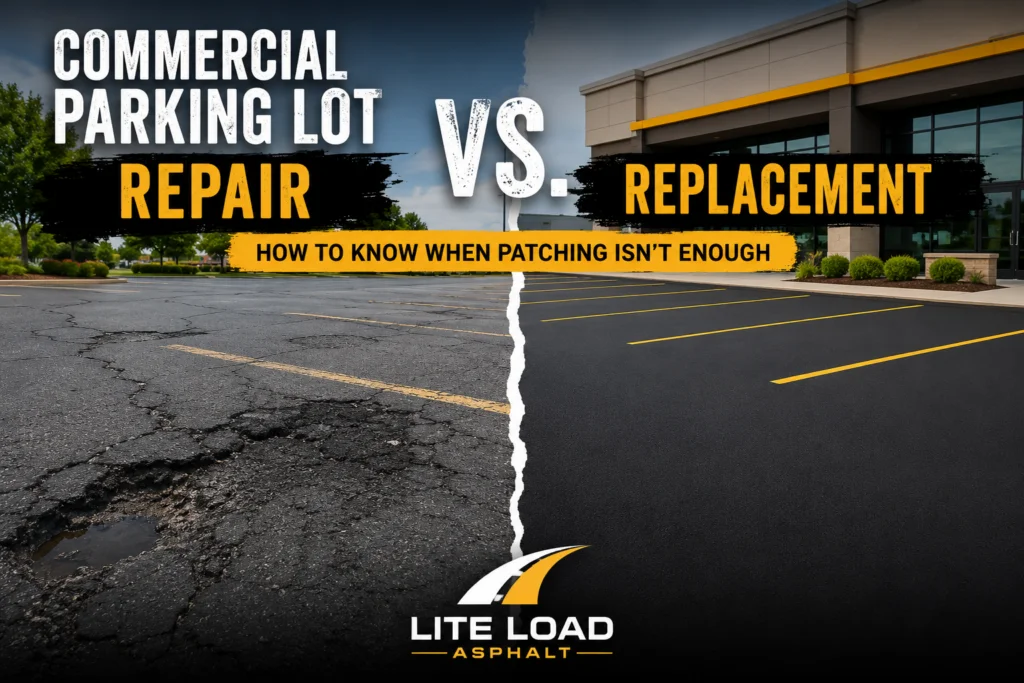
Somewhere between the first pothole and the full repave, every commercial parking lot crosses a line where repair stops being the economical choice and replacement starts being the smarter one. The commercial parking lot repair vs. replacement decision comes down to one rule, not to how the lot looks: when annual repair costs exceed 20–25% of replacement cost, or when more than 30% of the lot shows structural damage, replacement is the better investment. Crossing that line accidentally – by patching another year and another year and another year – is how owners end up spending 40–60% of a full replacement cost on repairs that don’t solve anything, only to replace the lot anyway.
This guide is for commercial property owners, facility managers, and industrial operators across Grand Rapids, Holland, Hamilton, Kalamazoo, Caledonia, Grand Haven, and the wider West Michigan region who are looking at their parking lot and asking, “Do I patch it again, or is it finally time?”
The Three Categories of Parking Lot Damage
Not all damage is created equal. Before deciding between repair and replacement, classify what you’re actually looking at. Commercial parking lot damage falls into three buckets, and the right response is different for each:
Category 1: Surface Damage (Repairable)
Linear cracks, minor raveling, faded surface, superficial potholes that haven’t reached the base, isolated oil saturation. These are maintenance-level issues. They respond well to crack filling, targeted patch repair, and sealcoating. Left untreated they worsen, but caught early they’re inexpensive to fix and don’t indicate any larger problem. Most lots under 12–15 years old with consistent maintenance history never progress past Category 1.
Category 2: Localized Structural Damage (Repairable, but watch closely)
Isolated alligator cracking in a specific zone, a single sunken area (often near a dumpster pad or drive aisle where heavy trucks repeat the same path), recurring potholes in one or two known spots. These indicate the base has failed in those specific areas – usually because of concentrated load, water intrusion at a specific seam, or an original construction defect. They can be fixed with section removal and replacement: saw-cut the failed area, dig out the bad base, rebuild with proper aggregate and asphalt. Cost is proportional to the area involved. A proper section repair is a permanent fix, not a patch.
The watch-closely part: if Category 2 damage keeps appearing in new locations, you’re not looking at localized problems – you’re looking at the early stages of systemic base failure. The lot is telling you it’s approaching Category 3.
Category 3: Widespread Structural Damage (Replacement Territory)
Alligator cracking spread across a large percentage of the lot, multiple sunken or heaved sections, drainage that no longer works, potholes that return to the same spots within a year of repair, previous patch work that has cracked along its edges, pavement that feels soft or flexes when heavy vehicles drive over it. At this point the base has failed broadly – not in one place – and repairing the surface without rebuilding the base is a guaranteed waste of money.
The lot hasn’t just reached the end of life; it has passed it. Every month of continued service is borrowed against safety and liability. This is replacement territory. Depending on how much of the base has failed, the right answer is either a full-depth resurface with section repairs or a complete repave.
The 20/25/30 Rule: Three Thresholds That Push the Decision Toward Replacement
These are the three quantitative thresholds we apply when clients are on the fence between continuing to repair and committing to replacement. Hitting any one of them is a yellow flag. Hitting two is a red flag. Hitting all three means you’re almost certainly losing money every year you defer replacement.
| The 20/25/30 rule at a glance
20% – annual repair spend exceeds 20% of replacement cost. 25% – more than 25% of the surface shows Category 2 or 3 damage. 30% – 30%+ structural damage, or 20+ years old with a resurface already done – the decision is effectively made. |
Threshold 1: Annual repair spend exceeds 20% of replacement cost
Track what you’ve actually spent on the parking lot over the past 3 years – cold-patch emergencies, pothole repairs, crack fill, section replacement, striping redo, and any incident-related costs (trip-and-fall claims, vehicle damage claims, temporary safety barriers). Compare the annual average against the cost of full replacement. If annual repair is running over 20% of what full replacement would cost, you are paying to rent a failing lot when you could be amortizing a new one.
Threshold 2: More than 25% of the surface shows Category 2 or 3 damage
Walk the lot. Estimate the damaged area as a percentage of total. Linear cracks that can still be filled don’t count – we’re measuring alligator cracking, sunken sections, existing patches, and severely raveled areas. Above 25% damage, a resurface no longer works (the new layer will crack along the old damage lines within one to two winters), and patch repair becomes so widespread that replacement is cheaper per square foot than repairing. At 30%+, the decision is effectively made for you.
Threshold 3: The lot is 20+ years old and has already been resurfaced once
Commercial asphalt in Michigan has a realistic service life of 20–25 years with good maintenance, and 12–15 years without it. A lot that’s been resurfaced once has already stretched that horizon – the second resurface doesn’t buy the same life because the base underneath is older and may be compromised. Past 20 years with one resurface already done, replacement is nearly always the better investment unless the base is unusually sound.
Real Cost Comparison: 10 Years of Repair vs. One Replacement
Abstract percentages are fine, but let’s walk through the math with a realistic West Michigan commercial example – a 20,000 sq ft retail parking lot that is 18 years old, never resurfaced, with visible Category 2/3 damage.
Scenario A: Keep Repairing (10-year horizon)
| Year | Work | Cost |
| Year 1 | Pothole repairs + crack fill + striping | $4,200 |
| Year 2 | More potholes, section repair on drive aisle, crack fill | $9,800 |
| Year 3 | Major section replacement near dumpster pad, sealcoat, striping | $14,500 |
| Year 4 | Patches failing along edges, new potholes, emergency cold-patch + spring re-patch | $11,200 |
| Year 5 | Trip-and-fall claim ($8,500) + repair work ($13,000) | $21,500 |
| Years 6–10 | Accelerating repair work (~$14k–$18k/yr) | ~$80,000 |
| Year 10 | Replacement – now overdue (lot is 28 yrs old) | $130,000 |
Total 10-year spend: ~$141,200 in repairs plus a $130,000 replacement at the end = ~$271,200 – and the lot was unsafe for the last 4+ years of that cycle.
Scenario B: Replace Now
| Year | Work | Cost |
| Year 1 | Full repave: demolition, new base, new pavement, striping, bollards | $120,000 |
| Year 2 | First sealcoat | $5,500 |
| Year 4 | Crack fill only | $1,200 |
| Years 5–6 | Second sealcoat cycle | $6,000 |
| Years 7–8 | Routine crack fill + minor patching | $2,500 |
| Years 9–10 | Third sealcoat + minor maintenance | $7,200 |
Total 10-year spend: $142,400 – on a lot that is still 10+ years from needing its next resurface, with no liability exposure from a deteriorating surface for the entire decade.
| The takeaway: Replacing now (~$142k) costs roughly half of patching to failure (~$271k) over the same decade – and removes years of safety and liability risk. |
Recurring Patches Are the Clearest Sign Your Base Has Failed
Of all the diagnostic signals in a commercial parking lot, the one we pay the most attention to is this: patches that fail. If a pothole is properly hot-patched during paving season – saw-cut square edges, base rebuilt and compacted, new hot-mix installed and compacted in lifts – the patch should last as long as the surrounding pavement. It’s a permanent fix, not a temporary one.
When a patch fails within 12–18 months, the patch wasn’t the problem. The base underneath it is moving. Water is still reaching it, freeze-thaw is still working on it, and the surrounding pavement is still pulling on it. A second patch in the same location will fail on the same timeline for the same reason.
This is the moment to stop patching and start replacing. Continuing to patch a failing base is the most expensive way to maintain a parking lot – because every dollar of labor and material on that repeat patch keeps the surface usable for less than a year.
The Hidden Costs of a Deteriorating Lot
The repair budget is only part of the true cost of a failing parking lot. Three other costs are harder to quantify but just as real:
Liability Exposure
Every pothole and trip hazard on a commercial property is a potential premises-liability claim. In Michigan, commercial property owners have a duty to maintain parking lots in reasonably safe condition for invitees (customers, clients, tenants, their guests). A failing parking lot with known hazards and inconsistent repair history is, legally speaking, exactly the kind of property that plaintiff’s attorneys look for. One slip-and-fall settlement can exceed the cost of full replacement. One vehicle-damage claim (a cracked rim from a pothole, a damaged oil pan from a sharp pavement edge) doesn’t settle for much individually – but the pattern of claims is the evidence used in the larger liability case that follows.
Customer and Tenant Perception
A deteriorating parking lot is the first thing customers see and the last thing they remember. For retail centers, medical offices, restaurants, and multi-tenant commercial properties, the visible condition of the lot directly affects perceived quality of the business inside it. For multi-tenant landlords, a bad lot complicates lease renewals and reduces the rent premium the property can command. These costs don’t show up on the maintenance ledger, but they absolutely show up in revenue.
Snow Removal Damage Acceleration
A cracked, uneven asphalt surface is dramatically harder and more damaging to plow. Plow blades catch raised edges, break off more pavement, and create new potholes every winter. A deteriorating lot actually accelerates its own decline during Michigan winters because the snow removal process itself worsens the damage. New, smooth pavement plows cleanly and cheaply; failing pavement costs more to plow and takes damage from every snow event.
What a Transparent Replacement Estimate Should Include
If the decision is leaning toward replacement, the estimate you request should be line-itemed – not a single bottom-line number. A proper West Michigan commercial replacement estimate should break out:
- Demolition and haul-off: square footage, depth, disposal fees.
- Base preparation: aggregate specification (MDOT Class II, 22A, or equivalent), thickness in inches, compaction method, any undercut allowance for soft spots.
- Asphalt binder course: MDOT mix designation (typically 3E or 4E), thickness in inches, tons estimated.
- Asphalt top course: MDOT mix designation (typically 4E or 5E), thickness in inches, tons estimated.
- Striping: stall count, fire lanes, ADA-compliant accessible stalls, signage, paint type (thermoplastic vs. acrylic).
- Drainage work: any grading corrections, catch basin adjustments, curb modifications.
- Bollards, wheel stops, curbing: unit pricing and quantities.
- Mobilization, permits, bonding: itemized rather than buried.
- Phasing plan: if the lot needs to stay partially open, a written phasing schedule.
- Timeline and weather contingency: expected duration and what happens if weather pushes the schedule.
- Warranty terms: what’s covered, for how long, and the process for claims.
If a bid skips any of those line items – or lumps them into a vague “site work” line – you don’t have enough information to compare it against a thorough estimate. That’s not always the contractor being dishonest, but it is a contractor who’s leaving room to cut scope after the job is awarded.
Related Reading on the Lite Load Blog
- Parking Lot Pavement Assessment – the 20-point commercial inspection checklist for West Michigan properties.
- When to Sealcoat vs. Resurface a Parking Lot – the maintenance decision tree that comes before replacement.
- Types of Asphalt – the mixes and grades behind a commercial asphalt lot, and where each one fits.
- Commercial Parking Lot Maintenance – the complete West Michigan property owner’s playbook.
| Not Sure Which Side of the Line You’re On?
Free on-site walk-through and a transparent, line-item estimate – repair or replacement, we’ll tell you straight. |
The Bottom Line: Know When You’re Past the Patching Window
Every commercial parking lot eventually crosses the line from “worth repairing” to “needs replacement.” That line is defined by math, not by how the lot looks or how emotionally ready the budget is. Annual repair spend over 20% of replacement cost, widespread structural damage over 25% of the surface, and age past 20 years with a resurface already in the rearview – these are the signals. Crossing even one of them without a plan is the point at which repair dollars stop working for you and start working against you.
Lite Load Services LLC has been maintaining and replacing commercial, industrial, and municipal parking lots across West Michigan since 1997. If your lot is showing signs that it might be past the patching window – recurring potholes, alligator cracking, sunken areas, repair spend climbing year over year – the honest next step is an on-site walk-through, a frank conversation, and a transparent line-item estimate for whichever direction actually makes sense. Sometimes that’s one more round of strategic repair and maintenance. Sometimes it’s time for replacement. We’ll tell you straight, either way.