

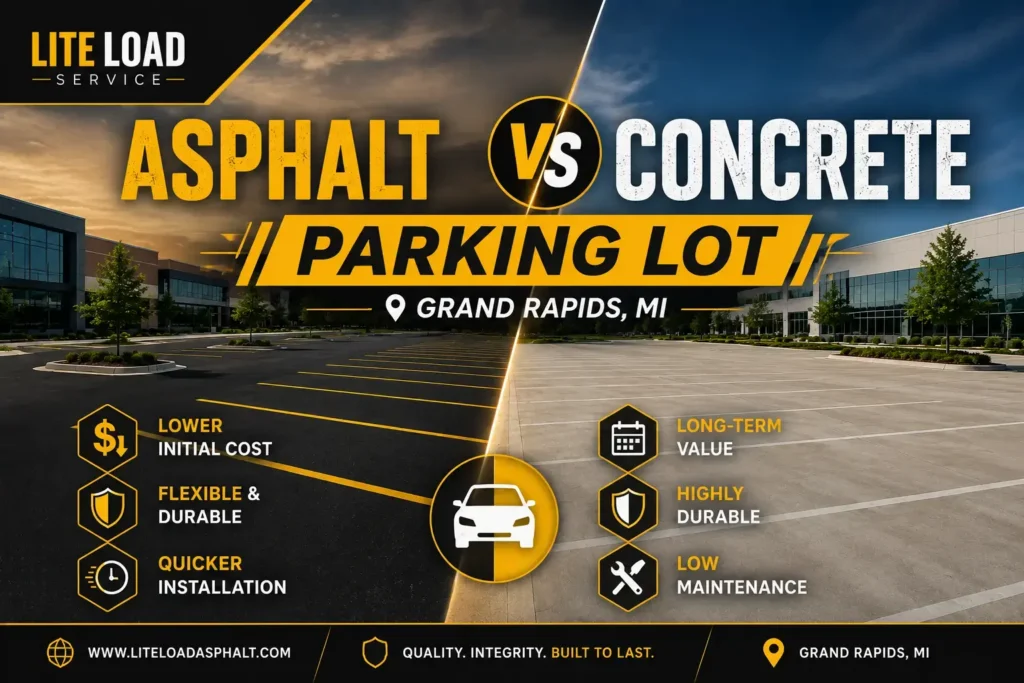
For most commercial parking lots in Michigan, the asphalt vs concrete parking lot decision comes down to this: asphalt costs roughly 40 to 50 percent less to install, goes back into service in days instead of weeks, and is far cheaper to repair, while concrete lasts longer on paper and handles concentrated heavy loads better. In Michigan’s freeze-thaw climate, asphalt’s flexibility and easy repairability win the lifecycle math for the large majority of commercial lots. Concrete earns its place in specific spots: loading docks, dumpster pads, and drive lanes where slow, heavy trucks sit and turn.
Lite Load Services LLC is a commercial asphalt paving contractor serving Grand Rapids and West Michigan since 1997, working out of Hamilton and covering Grand Rapids, Holland, Zeeland, Kalamazoo, Grand Haven, Muskegon, Caledonia, Kentwood, Wyoming, and the surrounding region. We install both materials through our parking lot paving services, so we have no reason to push one over the other; we spec the surface to the site. This guide lays out the real decision factors so a property owner or facility manager can make the call with eyes open, not on a contractor’s preference.
The Quick Answer
Asphalt is the better default for most Michigan commercial parking lots: lower upfront cost, faster return to service, easier and cheaper repairs, and flexibility that handles freeze-thaw movement well. Concrete is worth the premium in targeted high-load, low-speed areas, dock aprons, trash enclosures, and tight truck-turning zones where its rigidity and resistance to rutting pay off.
What This Guide Covers
- Side-by-side comparison of asphalt and concrete on the factors that matter
- Upfront cost vs. true lifecycle cost and why they tell different stories
- How Michigan’s freeze-thaw climate treats each material
- Repairability: the factor most owners underweight
- Where concrete genuinely beats asphalt on a commercial site
- A practical framework for choosing or combining the two
Asphalt vs. Concrete at a Glance
The two materials behave differently across every dimension that drives a parking lot decision. This table summarizes the trade-offs for a Michigan commercial application; the sections that follow explain the ones that matter most.
| Factor | Asphalt | Concrete |
| Upfront cost | Lower about $4.50–$8.00/sq ft to install | Higher, commonly 40–50% more than asphalt |
| Lifespan (maintained) | 25+ years with upkeep | 30–40 years |
| Return to service | Days driveable within 1–2 days | Weeks 7+ days to cure before traffic |
| Repairability | Easy, cheap, blends in; patch or overlay | Hard patches are visible and costly |
| Freeze-thaw behavior | Flexes with movement; resists cracking | Rigid; prone to slab cracking and heave |
| De-icing salt | Tolerates salt well | Salt and freeze-thaw can scale the surface |
| Heavy static loads | Can rut under slow, concentrated loads | Excellent for docks and pads |
| Maintenance | Sealcoat every 2–3 yrs, crack fill | Joint sealing, less frequent but pricier |
Upfront Cost vs. Lifecycle Cost
On the day of install, asphalt is clearly cheaper. A new commercial asphalt parking lot typically runs about $4.50 to $8.00 per square foot depending on thickness, base work, and site conditions. Concrete commonly lands 40 to 50 percent higher, sometimes more once you account for the deeper base and longer schedule it needs.
Concrete advocates counter with lifecycle cost the spread-over-time math, and they are not wrong that concrete’s 30-to-40-year lifespan can beat asphalt’s 25-plus. But that comparison only holds if two things are true: the concrete does not crack early in Michigan’s climate, and the asphalt is left unmaintained. Neither is a safe assumption. A maintained asphalt lot routinely reaches and passes 25 years, and when it finally needs renewal, a resurfacing overlay restores it for a fraction of a full concrete replacement. The lifecycle gap narrows fast once you put real maintenance behind the asphalt.
How Michigan’s Climate Treats Each Material
This is where the Michigan answer diverges from a generic one. A West Michigan winter runs an average of 42 freeze-thaw cycles that water works into the pavement, freezes, expands, and pries it apart, over and over. The two materials handle that assault very differently. For a deeper look at what a single season can do, see Parking Lot Winter Damage in Michigan.
Asphalt: Flexible
Asphalt is a flexible pavement. It moves with the ground as it freezes and thaws, and that give is exactly what lets it survive Michigan winters with surface-level cracking that is cheap to seal and fill. When it does crack, the cracks tend to be linear and repairable rather than catastrophic. The vulnerability is water intrusion, which is why sealing and crack filling matter so much here.
Concrete: Rigid
Concrete is a rigid pavement. It does not flex; it relies on control joints and a stable base to manage movement. When Michigan’s frost heave lifts the ground unevenly, concrete slabs can crack across the middle or lift at the joints, and those failures are expensive to fix. De-icing salt compounds it: repeated salt exposure combined with freeze-thaw can scale a concrete surface, flaking the top layer off in a way asphalt simply does not experience. Properly air-entrained, jointed, and based concrete holds up, but the margin for a cut corner is thinner.
| Deciding between asphalt and concrete for your lot?
We install both and will tell you honestly which fits your site, traffic, and budget. Call (269) 751-6037 or request a commercial parking lot estimate. Serving Grand Rapids and West Michigan since 1997. |
Repairability: The Factor Owners Underweight
Every parking lot eventually gets damaged: a delivery truck digs in, a section ruts, a utility cut goes through. What happens next is wildly different between the two materials, and it is the factor commercial owners most often overlook at decision time.
Asphalt repairs are fast, cheap, and nearly invisible. A failed section is saw-cut, removed, and patched with fresh hot mix that bonds to the surrounding pavement; after the next sealcoat, the patch blends into a uniform surface. The lot stays open through most of it. Parking lot repair on asphalt is routine maintenance, not a project.
Concrete repairs are the opposite. You generally cannot patch a slab seamlessly; a repair means removing and replacing a full slab section, the color and texture rarely match, and the area is out of service for a week or more while it cures. For a lot that takes daily abuse, that difference compounds into real money and real disruption over the pavement’s life.
Where Concrete Genuinely Wins
None of this means concrete is wrong; it means concrete is a tool for specific jobs. On a commercial or industrial site, concrete earns its premium in places where loads are heavy, slow, and concentrated:
- Loading dock aprons. Trucks back in, sit, and pivot under full weight; concrete resists the rutting that slow heavy loads cause in asphalt.
- Dumpster and trash-enclosure pads. Garbage trucks plant outriggers and crush the same spot weekly a classic asphalt failure point and a natural concrete pad.
- Tight truck-turning zones. Where heavy vehicles turn sharply at low speed, the twisting force scuffs and shoves asphalt; concrete shrugs it off.
- Drive-through and fuel-island lanes. Constant idling and fluid drips in one footprint favor concrete’s rigidity and chemical resistance.
This is why the smartest commercial lots in Michigan are often not one material or the other; they are asphalt for the drive lanes and stalls, with concrete placed surgically where the loads demand it.
Commercial Parking Lot Paving Costs in Grand Rapids & West Michigan
Pricing shifts by market, so a Michigan-specific range matters more than a national average. For commercial asphalt paving in Grand Rapids MI, expect the same $4.50–$8.00 per square foot band cited above, with the top of that range driven by deeper base rock, extensive grading, or drainage work common on older commercial sites in Hamilton, Holland, Zeeland, and Kalamazoo where lots are being rebuilt rather than paved fresh. Concrete parking lot cost in Michigan runs 40–50% above that, and rises further on projects that need reinforced slabs for loading dock aprons or heavy industrial traffic in Grand Haven and Muskegon.
Because every site brings its own subgrade, traffic pattern, and drainage profile, an accurate number requires a walkthrough rather than a phone quote. As a commercial paving contractor working across West Michigan Grand Rapids, Caledonia, Kentwood, Wyoming, and beyond we price parking lot paving and concrete work the same way: measure the site, map the loads, and quote both materials so the property owner can compare real numbers instead of rules of thumb.
A Practical Way to Choose
Strip away the sales pitches and the decision is usually clear. Work through it in this order:
- Map the loads. Identify where heavy vehicles sit, pivot, or concentrate weight. Those zones are concrete candidates.
- Default the rest to asphalt. Drive lanes and standard parking stalls almost always pencil out better in asphalt for Michigan commercial use.
- Weigh schedule and disruption. If the lot cannot be closed for weeks, asphalt’s days-not-weeks return to service may decide it on its own.
- Commit to maintenance either way. Both materials live or die on upkeep. Sealing and crack filling for asphalt; joint sealing for concrete. Budget for it from day one.
The Bottom Line
For the large majority of commercial parking lots in Michigan, asphalt is the better default lower upfront cost, faster return to service, easy and inexpensive repairs, and the flexibility to ride out ~42 freeze-thaw-cycle winters. Concrete is not a worse material; it is a specialized one, and it earns its premium in the loading docks, dumpster pads, and truck-turning zones where its rigidity is exactly what the job needs.
The best decision is rarely all-or-nothing. After 28 years building West Michigan commercial pavement, our advice is to map your loads, default the rest to asphalt, and commit to maintenance whichever way you go. Get that framework right and the lot will serve you for decades not just survive its first few winters.
| Get a no-pressure read on your commercial lot.
Lite Load Services installs and maintains both asphalt and concrete across West Michigan. Call (269) 751-6037 or contact us for a free commercial estimate. |