

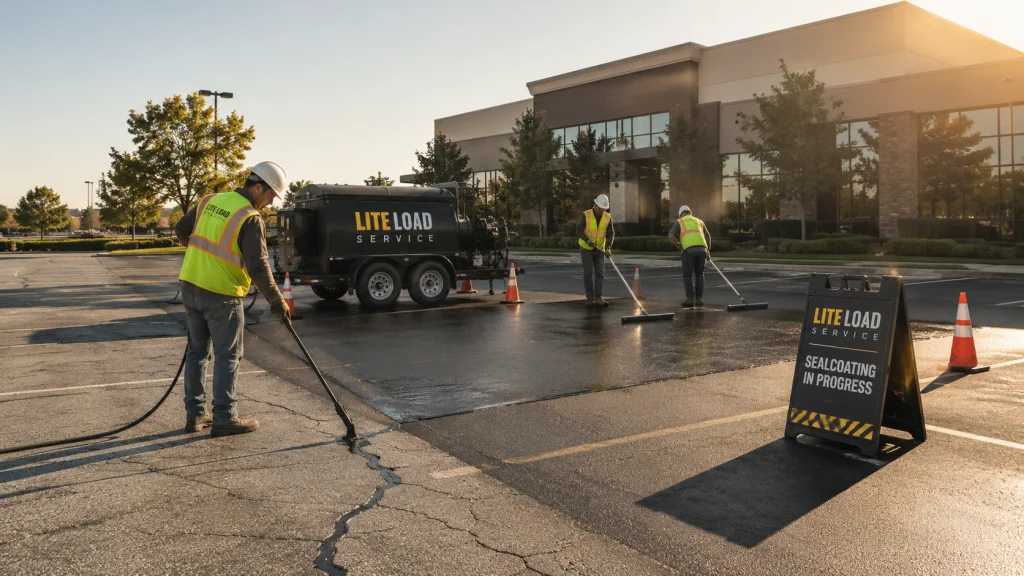
Deciding when to sealcoat vs. resurface a parking lot – and where crack filling fits between them – comes down to one question: is the damage on the surface, or in the base? Sealcoating is preventive protection for a structurally sound lot; it blocks UV, water, and chemical damage but does not repair anything. Crack filling is a targeted repair that seals individual cracks before water can reach the base. Resurfacing is the rehabilitation step taken when surface maintenance can no longer keep pace and the pavement needs a fresh layer. Using the wrong one at the wrong time is the most common reason commercial parking lots fail years earlier than they should.
This guide is the decision tree that Lite Load Services walks commercial clients through when they ask, “What does my lot actually need this year?” After 28 years of maintaining West Michigan commercial and industrial parking lots, the pattern that separates lots lasting 25+ years from lots failing at 12 is not the quality of the initial paving – it’s whether the owner got the sealcoat vs. crack fill vs. resurface decision right at each maintenance checkpoint.
| The one – minute version: If your lot is structurally sound and just looks faded → sealcoat. If you can count the cracks → crack fill (and seal after). If you can’t count the cracks → your past maintenance has run its course; it’s time to talk about resurfacing or repaving. |
What Each Service Actually Does
Sealcoating
Sealcoating is a liquid protective coating – typically a coal – tar or asphalt emulsion – applied in a thin layer over an existing, structurally sound asphalt surface. It doesn’t fix damage. It doesn’t fill cracks. What it does is shield the pavement from the three things that age asphalt fastest: UV radiation (which oxidizes the binder), water (which penetrates and, in Michigan, freezes), and chemicals like motor oil and deicing salts (which break down the binder).
A quality commercial sealcoat application restores the rich black surface color, smooths minor surface texture, and – most importantly – buys the pavement 2 to 4 more years of life per application. Applied every 2–3 years on a commercial lot, sealcoating can reasonably double the effective lifespan of the asphalt underneath it.
Sealcoating is preventive, not corrective. It works on lots that are already in good condition. It does not rescue lots that are already failing.
Crack Filling (Crack Sealing)
Crack filling is a targeted, surgical repair. Hot – applied rubberized crack sealant is pressurized into individual cracks, bonds to both crack walls, and forms a flexible waterproof seal. The goal is simple and powerful: stop water from reaching the base. In West Michigan, where freeze – thaw drives water damage, a single unsealed crack can destroy the pavement structure around it in 2–3 winters. A sealed crack holds for 3–5 years.
Crack filling is cost – effective far out of proportion to how it looks. The actual material cost is trivial. What you’re really buying is the avoided damage – the pothole that doesn’t form, the base repair you don’t need, the section removal you don’t have to budget for. Lite Load’s sealcoat and crack filling service handles both applications in a coordinated single visit where appropriate, because crack filling almost always happens before sealcoating – not after.
Resurfacing
Resurfacing is the rehabilitation step taken when maintenance can no longer keep pace with damage. It involves milling off the top 1.5 – 2 inches of deteriorated pavement and installing a fresh layer of hot – mix asphalt on top of the existing base. It’s not maintenance – it’s capital improvement. Properly executed on a sound base, a commercial resurface typically adds 8–15 years of pavement life.
Resurfacing is the right answer when sealcoating and crack filling stop being economical – when too many cracks have opened to fill individually, when the surface has degraded past cosmetic recovery, or when the maintenance budget on patching and filling is approaching 20–25% of resurfacing cost annually. For the complete framework, our companion article Asphalt Resurfacing vs. Repaving in Michigan goes deeper.
The Decision Tree: When to Sealcoat vs. Resurface (and When to Crack Fill Instead)
Work the five questions below in order. Each one moves you toward sealcoating, crack filling, or resurfacing based on what your lot is actually telling you.
Question 1: Can you count the cracks?
Walk the main drive aisles and parking rows. If you can realistically count the cracks and potholes – say, fewer than 50 or so across the entire lot – you’re in maintenance territory. Move to Question 2.
If the damage is widespread – if you’d have to estimate the cracks by the square yard rather than count them – you’re past maintenance. Skip to “The Five Signs You’re Past the Maintenance Window” below.
Question 2: Is there any alligator cracking, or are there sunken sections?
Alligator cracking (the interconnected, scale – like pattern) and sunken sections are base failures. Sealcoating over base failure makes it look better for 60 days, then fails along the exact same lines. Crack filling on alligator cracking is wasted labor – the cracks are too wide, too numerous, and structurally different from linear cracks.
If you see alligator cracking or sunken sections, stop – sealcoating and crack filling aren’t the right answer for those areas. You likely need section removal and replacement on those specific areas (and potentially a full resurface if they’re widespread). Call for an inspection before doing any surface – level maintenance that will just go to waste.
Question 3: Are the cracks narrow (under a half – inch) or wide?
Narrow cracks – hairline up to about 3/8” – are ideal crack – filling candidates. Hot rubberized sealant bonds the crack walls and seals it for years.
Wider cracks – a half – inch or more – often can’t be effectively filled and usually indicate the pavement is working too much (either thermal movement or underlying structural movement). Wide cracks may need saw – cut patch repair rather than filling. When you see several wide cracks across the lot, you’re approaching the line where resurfacing becomes the better investment.
Question 4: How long has it been since the last sealcoat?
If the answer is “never” or “longer than 5 years,” and the surface is still structurally sound, sealcoating is overdue. The surface has been accumulating UV and chemical damage that sealcoating slows down. One application won’t reverse the damage already done, but it will significantly slow what comes next.
If the answer is “2–3 years ago” and the surface looks lightly faded, you’re right on the normal commercial re – application cycle. Schedule it.
Question 5: Have you had cracks filled before? How have they held?
If previously filled cracks are holding (the filler is still in place, no new cracking right beside them), your maintenance program is working. Continue. If filled cracks have opened up or new cracks are forming next to them, the underlying pavement is moving more than crack filling can keep up with – and resurfacing is starting to look like the better investment.
| Decision summary:
(A) Sound lot, faded surface, no or few small cracks → sealcoat. (B) Sound lot with countable linear cracks → crack fill, then sealcoat. (C) Widespread cracks, some alligator cracking, or sunken sections → resurface or repave. Sealcoating a failing lot does not save it – it postpones replacement by six months while wasting the sealcoat cost. |
Why the Order of Operations Matters
When sealcoating and crack filling are both scheduled for the same lot (which is common), the order is not negotiable: crack filling first, sealcoating second, at least 24 hours between. Here’s why:
Crack filler needs to be set before being covered. Hot rubberized sealant needs time to cool and cure. Sealcoating over fresh crack filler traps heat and can distort the seal.
Sealcoat can’t fill cracks. Sealcoating applied directly over unfilled cracks does not bridge them – the sealcoat cracks right along with the pavement. The cracks need to be filled first so the sealcoat creates a continuous surface.
Striping comes last. Sealcoating wipes out existing striping. Re – stripe after sealcoating, not before. Plan for a lot closure that accommodates all three services in sequence – typically a 3 – day window for a mid – size commercial lot.
Michigan – Specific Timing: When Each Service Can Be Done
West Michigan’s climate sets hard limits on when each service can be performed. Here’s the reliable seasonal window for each:
| Service | Reliable Window | Sweet Spot | Hard Limit |
| Sealcoating | Mid – May – late Sept. | June – August | Needs 50°F & rising, dry 24 hrs; fails below 50°F |
| Crack Filling | April – October | Late summer / early fall | Cooler air = widest cracks, best penetration |
| Resurfacing | Late April – mid – Oct. | June – August | Hot – mix needs 50°F & rising to compact |
Sealcoating below 50°F does not cure properly and fails prematurely – November through April is effectively out of the question. Planning a resurface for 2026? Book the estimate by March if possible.
Cost Ranges for Commercial Lots in West Michigan
Rough 2026 ranges for a standard 20,000 sq ft commercial parking lot in the Grand Rapids / West Michigan area:
| Service | Unit Cost | Typical Total (20,000 sq ft) | Frequency |
| Sealcoating | $0.15 – $0.35 / sq ft | $3,000 – $7,000 | Every 2–3 years |
| Crack Filling | $1.00 – $2.50 / linear ft | $300 – $1,250 (200–500 lf) | As needed |
| Sealcoat + Crack Fill | Combined | $3,500 – $8,500 | Best per – dollar preservation |
| Resurfacing | $2.00 – $4.00 / sq ft | $40,000 – $80,000 | Every 10–15 years |
| The lifecycle math: Spending $1,500–$3,000 per year on proper sealcoat and crack – fill maintenance typically defers a $60,000+ resurface by 5–10 years. Over a 25 – year horizon, the compound savings on a single commercial lot commonly exceed $75,000. Deferred maintenance is not a saving – it’s a loan against future capital spending, at a very high interest rate. |
The Five Signs You’re Past the Maintenance Window
Sometimes the answer isn’t sealcoat or crack fill – it’s “your lot is past the point where surface maintenance helps.” Here are the clear signs:
- Widespread alligator cracking. More than a few isolated patches means the base is failing structurally. Nothing you put on top of it will fix that.
- Multiple sunken or heaved areas. Indicates the sub – base is no longer stable. Resurfacing alone may not be enough – a full repave may be needed.
- Standing water that doesn’t drain within 24 hours. Drainage failure is a structural problem that maintenance cannot address.
- Previous crack fills have opened back up, or new cracks form right beside them. The pavement is moving faster than filling can keep up with. Filling more cracks throws good money away.
- Your annual patch – and – fill spend is over 20% of the cost of a full resurface. At that rate, the maintenance is no longer an investment – it’s a lease.
If any two of those signs are present, stop the maintenance cycle and commission a professional inspection.
| Schedule Your Annual Lot Evaluation
Free on – site walk – through. Sealcoating, crack filling, and full maintenance programs across West Michigan. |