

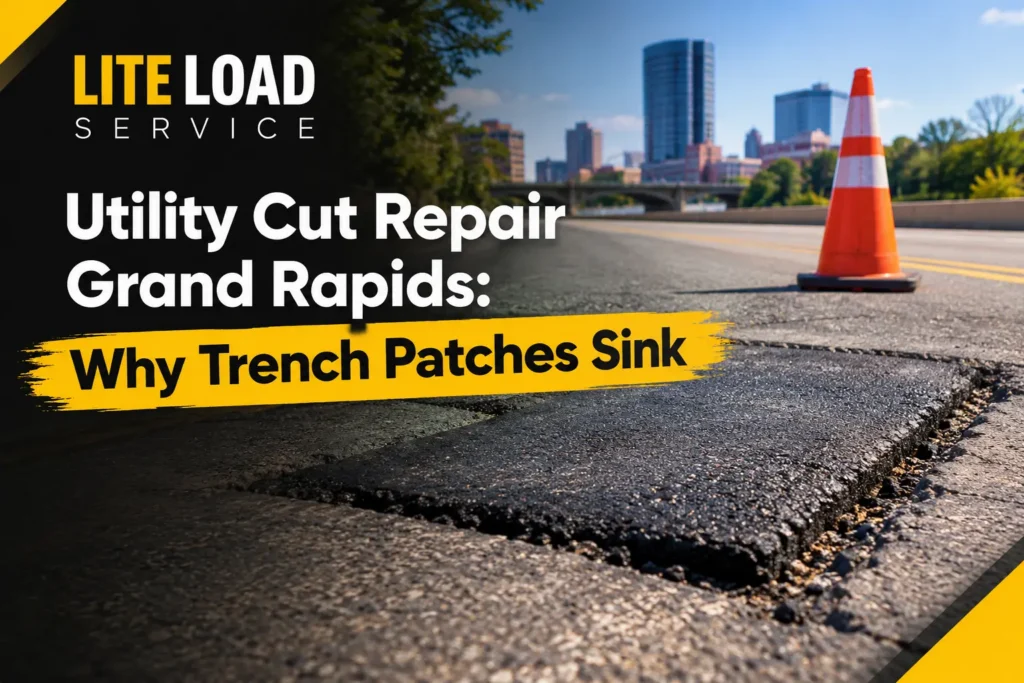
Utility cut repair in Grand Rapids fails most often because the trench underneath the asphalt was never compacted properly, not because the asphalt itself was bad. Trench patches sink when loose backfill settles, water gets into the patch seams, and Michigan freeze-thaw cycles push and pull the soil. The most durable fix is a T-patch asphalt repair: crews cut back 6 to 12 inches of sound pavement on each side of the trench, so the new asphalt bridges onto solid ground and the seams sit on a stable base.
Key takeaways
- A sunken trench patch is a base problem first and a surface problem second.
- Backfill should go in thin lifts, each one compacted, instead of being dumped in all at once.
- A T patch staggers the joints, spreads wheel loads, and keeps water out of the trench.
- In West Michigan, sealing patch edges before winter adds years to a utility cut repair.
- A small sunken patch in a parking lot can usually be fixed without repaving the whole lot.
A Patch That Looked Fine in October
A water line gets replaced in front of your building in the fall. The crew backfills the trench, throws down a strip of hot asphalt, rolls it, and leaves. It looks clean. By April, there is a long, shallow dip running across the drive lane, and the edges of the patch have started to crack and pull away from the old pavement.
If you manage a commercial property in Grand Rapids, you have probably seen this exact scene. Utility work is constant across West Michigan: gas, water, sewer, storm, electrical, fiber. Every one of those jobs leaves a cut in the pavement, and every cut needs a proper utility cut repair. Too many of them get a quick patch instead.
At Lite Load Services, we have been fixing pavement across West Michigan since 1997, and sunken utility trenches are among the most common problems we see on commercial lots and access roads. This guide explains why trench patches sink, what a T-patch asphalt repair is, how utility trench patching in Michigan should be done, and what your options are when a patch in your parking lot has already dropped.
What Is a Utility Cut Repair?
A utility cut repair is the work of restoring pavement after it has been cut open to reach a buried line. It covers everything from the bottom of the trench up: the backfill, the aggregate base, and the new asphalt surface.
Here is the catch. Your original pavement was built as one system. The subgrade was graded and compacted, the base was placed in layers, and the asphalt was laid over a uniform foundation. The day someone saws through it and digs a trench, that system is broken. You now have a strip of disturbed soil running through pavement that has had years, maybe decades, to settle and stabilize.
The new trench and the old pavement around it will never behave exactly the same. They carry load differently, hold water differently, and react to temperature differently. A good utility cut repair accepts that and is built to manage the difference. A bad one just covers it up.
Why Do Trench Patches Sink?
Trench patches sink because the material under the asphalt keeps settling after the crew leaves. The main causes are poorly compacted backfill, water getting in through the patch seams, backfill that doesn’t match the surrounding soil, and Michigan’s freeze-thaw cycles. In most cases, two or more of these are working together.
1. The backfill was not compacted in lifts
This is the big one. Soil that has been dug out is fluffed up and full of air. Put it back in a deep trench all at once, run a roller over the top, and you only compact the upper few inches. The rest sits loose underneath.
Then traffic arrives. Every car, delivery truck, and garbage truck pushes that loose soil down a little further. Within a season, the asphalt follows it, and you have a dip.
The right way is to place backfill in thin lifts, typically 6 to 8 inches at a time, and compact each lift with a plate compactor or trench roller before adding the next. It takes longer. That’s why it gets skipped.
2. Water gets into the seams
Every patch has a joint where new asphalt meets old. If that joint is a single straight vertical cut, it becomes a channel for water. Rain and snowmelt run down the seam, soak the base, and soften the backfill. A wet base loses strength fast, and soft backfill settles even faster.
3. The backfill doesn’t match the native soil
Some crews backfill with whatever came out of the hole, including clay chunks, broken asphalt, or organic soil. Others use clean stone in a trench surrounded by dense clay. Either way, two materials with different settling rates and load capacities now sit side by side. The weak point always ends up at the edge of the trench, right where the patch joint is.
4. Michigan freeze-thaw cycles
Grand Rapids goes through dozens of freeze-thaw cycles every winter. Water in the base freezes, expands, and lifts the pavement. It thaws, the soil is left loose and saturated, and the patch drops a little lower than before. Repeat that 30 or 40 times between November and March, and a patch that was flush in the fall is visibly sunken by spring.
5. The patch was too thin or the wrong mix
Some utility patches are a thin layer of cold patch meant to hold traffic for a few weeks. They are temporary by design. When nobody comes back to replace them with a permanent hot-mix patch at the proper depth, they break down and sink.
If you want a quick way to tell which problem you are dealing with, our guide on surface damage vs base failure in parking lots walks through the signs. A sunken trench patch is almost always a base issue.
What Is a T Patch Asphalt Repair?
A T patch asphalt repair is a trench patch where the new asphalt extends past the edges of the trench and rests on undisturbed pavement base on both sides. Seen in cross-section, the deep asphalt over the trench and the wider, shallower cut on each side form the shape of a “T.” Some crews call it a bridge patch or T-cut patch.
The process is simple to describe. After the trench is backfilled and compacted, the crew saws or mills back the existing asphalt 6 to 12 inches beyond each trench wall, down to a set depth. Then the whole area is paved: full depth over the trench, and a shallower layer over the shoulders on each side.
Why a T patch outlasts a flush patch
A standard flush patch has one vertical joint on each side, running straight down from the surface to the trench. That joint is the weakest line in the whole repair. A T patch fixes three problems at once.
- It bridges the trench. The asphalt shoulders sit on old, settled base. Even if the backfill settles slightly, the patch is supported at its edges instead of hanging over loose soil.
- It staggers the joints. The surface joint and the trench wall are no longer in the same place. Stress from wheel loads spreads across a wider area instead of concentrating on one seam.
- It blocks water. With the joints offset at different depths, water entering at the surface can’t run straight down into the trench. That matters a lot in freeze-thaw country.
- It hides minor edge damage. The saw cut and excavation usually crack and loosen the pavement right at the trench edge. A T patch removes that damaged strip and replaces it.
Is a T patch always worth it?
Not always. A T patch costs more because there is more asphalt to remove and more to replace. If a lot is scheduled for full asphalt resurfacing next season, a well-compacted flush patch may be enough to get you there. Some municipal permits also spell out exactly which patch style is required in the right-of-way.
But on a busy commercial lot, a truck route, or a loading area that you expect to keep for years, a T patch is usually the cheaper option over the life of the pavement. You pay a little more once instead of paying to fix the same dip every spring.
How Utility Trench Patching in Michigan Should Be Done
Proper utility trench patching in Michigan follows the same basic order on almost every job: clean cuts, correct backfill placed in thin compacted lifts, a solid aggregate base, a T-cut on stable pavement, hot-mix asphalt at the right depth, and sealed joints. Here is what each step looks like and what tends to go wrong.
- Make clean, straight cuts. The pavement is saw-cut or milled along straight lines, square to the direction of traffic where possible. Ragged, broken edges are hard to seal and fail first.
- Remove all loose and failed material. Any soft, wet, or contaminated soil at the bottom of the trench comes out. Paving over soft subgrade guarantees a sunken patch, no matter how good the asphalt is.
- Backfill in lifts. Granular backfill goes in 6 to 8 inches at a time, and each lift is compacted before the next. Many specifications call for compaction to around 95% of maximum density, checked with field testing on larger jobs. What goes wrong: dumping the whole trench and compacting only the top.
- Place and compact the aggregate base. A layer of crushed aggregate goes on top of the backfill, graded and compacted to match the surrounding base. This is the platform the asphalt sits on.
- Cut back for the T. The existing asphalt is trimmed back on each side of the trench, typically 6 to 12 inches, down to the planned depth. Edges are cleaned of dust and debris.
- Apply tack coat. All vertical and horizontal edges get a tack coat so the new asphalt bonds to the old instead of just sitting next to it.
- Pave with hot-mix asphalt. Deep trenches get paved in more than one lift, each one rolled. The final surface should finish flush or very slightly above the existing pavement, since it will settle a hair under traffic. What goes wrong: one thick lift that never compacts in the middle.
- Seal the joints. Once the patch has cooled, the seams are sealed to keep water out. Our sealcoat and crack filling work is often done right alongside patching for this reason.
Skip any one of these and the patch is on borrowed time. In our experience, step 3 is where most failed utility patches went wrong. Steps 5 and 8 are where good patches become great ones.
Sunken Patch Parking Lot Fix: Your Options
The right sunken patch parking lot fix depends on how deep the dip is and whether the base underneath is still moving. Shallow, stable dips can be leveled from the top. Deeper or still-settling patches need to come out and be rebuilt from the base up.
| Condition | What you see | Typical fix |
|---|---|---|
| Minor settlement | Dip under 1 inch, edges tight, no cracking | Mill the surface and overlay with a thin hot-mix leveling course, then seal the edges |
| Moderate settlement | Dip of 1 to 2 inches, open seams, some edge cracking | Cut out the old patch, recompact the base, and install a T patch |
| Severe failure | Dip over 2 inches, alligator cracking, pumping water or soft spots | Full-depth removal, dig out wet backfill, rebuild base in lifts, then T patch |
| Spreading damage | Cracks and settling reaching beyond the old trench | Larger section repair or resurfacing of the affected area |
A quick test you can do yourself: after a rain, look at the patch. If water stands in it for hours, the dip is deep enough to hold water, and that water is soaking into the seams every time it rains. That patch will keep getting worse.
The mistake we see most often is “topping off” a sunken patch with more asphalt year after year without fixing the base. It looks better for a few months. But the backfill keeps settling, the patch keeps getting thicker and heavier, and eventually the edges break apart. If your lot has a patch that has already been topped off twice, it’s time to dig it out.
For most commercial properties, a sunken trench patch is one item on a bigger list. Our parking lot repair crews usually handle trench patches together with potholes, edge cracks, and drainage fixes in a single visit, which keeps your lot open and your costs down.
Michigan Timing, Weather, and Permits
Timing matters more in West Michigan than in most places. Hot-mix asphalt needs warm ground and warm air to compact properly. Most local asphalt plants slow down or close for the season sometime in late fall and reopen in spring, and patching in near-freezing conditions produces a patch that cools before it can be fully compacted.
That creates a common problem. Utility work happens all year. When a trench is cut in December, the crew has to cover it with something, and that something is usually cold patch. Cold patch is a temporary material. It is meant to be replaced with a permanent hot-mix patch once the season opens up.
If you have a cold-patched trench on your property from winter utility work, plan for permanent repair in spring. The best window in Grand Rapids is usually May through October, when the ground has dried out and temperatures are steady.
Two more things to keep in mind:
- Who is responsible? If a utility company or its contractor cut your private lot, they may be responsible for restoring it. Check any agreement or easement before you pay for the repair yourself, and take dated photos of the patch as it settles.
- Right-of-way work needs permits. Cuts in public streets and sidewalks in Grand Rapids and surrounding cities fall under the local right-of-way rules, which set their own restoration standards. Private parking lots generally don’t need a street-opening permit, but the work should still meet good engineering practice.
Warning Signs, Repair vs Replace, and Cost Factors
Catching a failing trench patch early is the cheapest way to deal with it. Watch for these signs on your property:
- A visible dip or “bathtub” along the line of an old utility cut
- Open seams where the patch meets the original pavement
- Hairline cracks running parallel to the patch edges
- Water standing in the patch after rain
- Cars or trucks bumping noticeably when crossing the patch
- Alligator cracking (a pattern like reptile skin) inside the patch
If you catch it at the first two signs, you are often looking at sealing and a light leveling course. Once alligator cracking shows up, the base has failed and the patch needs to be rebuilt.
What drives the cost of a utility cut repair? Every job is priced on site, but these are the factors that move the number:
- Size of the patch, measured in length, width, and depth
- Whether the backfill has to be dug out and replaced
- T patch versus flush patch
- Access, traffic control, and how much of the lot has to be closed
- Whether the patch can be bundled with other asphalt repair work on the same visit
As a rule, fixing one trench patch the right way costs less than patching the same spot three times. That’s the whole argument for doing it properly.
Utility Cut Repair in Grand Rapids from a Local Paving Crew
Lite Load Services is a family-run, MDOT pre-qualified asphalt contractor based in Hamilton, Michigan, serving Grand Rapids, Holland, Zeeland, Kalamazoo, Grand Haven, Muskegon, and the rest of West Michigan since 1997. Our crews handle the full repair in-house: cutting, excavation, base work, compaction, paving, and sealing.
That matters for trench patches. When the same crew that compacts the base also lays the asphalt, nobody gets to skip a lift and hand the problem to someone else.
If you have a sunken utility patch on your lot or access drive, or a cold-patched trench from winter work that needs a permanent fix, contact Lite Load Services or call (269) 751-6037 for a free on-site estimate. We’ll tell you honestly whether you need a leveling course, a T patch, or a full base rebuild.