

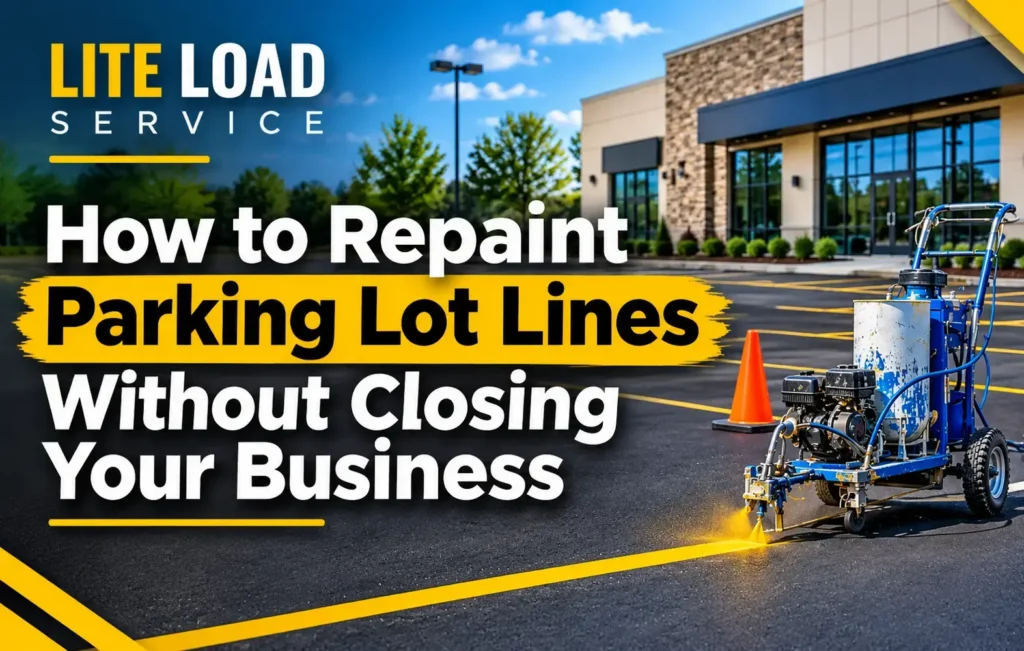
You can repaint a commercial lot without closing it. Stripe in zones, work in off-hours, and reopen each zone once the paint dries. Prepare first: sweep, fill cracks, and finish sealcoating at least 24 hours earlier. Paint only when air and pavement stay above 50°F. Match ADA stall and aisle dimensions exactly. Choose a crew with in-house striping so the schedule holds.
______________________________________________________________________
Knowing how to repaint parking lot lines without losing a day of sales comes down to sequencing. Faded stripes hurt safety and first impressions, yet a full shutdown costs more than the paint. Zone work, off-hour crews, and fast-drying materials keep customers parking while new lines go down. This guide covers the prep list, timing rules, and layout standards. It also shows when a DIY approach works and when it backfires.
Key Takeaways
- Full closures are rarely needed. Zone work keeps stalls open for customers.
- Sealcoat first and stripe last. Sealer covers old lines.
- Wait at least 24 hours after sealcoating, and paint only above 50°F.
- Fast-dry traffic paint can dry in minutes, but follow the label.
- ADA car stalls need a 96 inch width and a 60 inch access aisle.
Can Your Lot Stay Open While The Lines Go Down?
Short answer: Yes. Divide the lot into zones, paint one zone at a time, and keep the rest open for customers.
How Big Should Each Closed Zone Be?
Size each closed zone so the open stalls still cover your peak-hour count. Count occupied stalls during your busiest hour, then close only the surplus. Phasing is the heart of how to repaint parking lot lines on a working property. Mark each zone on a site plan and share it with staff, tenants, and delivery drivers.
How Do You Keep Customers Off Wet Paint?
Place cones and caution tape at each zone entrance, and post A-frame signs facing approaching drivers. Station a staff member at busy entrances. Mark a walking route to the front door that avoids wet zones. SealMaster’s acrylic traffic paint specification lists a dry to no pick-up time under 30 minutes. The company says its fast-dry version dries in under 5 minutes. Always follow the label for your product and weather before reopening a zone.
What Needs Fixing Before The First Line Is Painted?
Short answer: Clean the surface, repair damage, measure the old layout, and confirm the weather. Paint bonds poorly to dirt, cracks, and damp pavement.
- Sweep and clean. Remove gravel, debris, and oil. SealMaster requires a clean, dry surface.
- Fill cracks and potholes. Lines painted across open cracks break up first.
- Turn off sprinklers. A common rule is 12 hours ahead, or 24 hours for shaded or cool lots.
- Measure the existing layout. Record stall counts, aisle widths, and ADA positions before sealer buries them.
- Check the forecast. Rust-Oleum’s technical data calls for 50 to 90°F, with the surface 5°F above the dew point.
Surface condition decides how long new lines last. If cracking keeps returning, the problem may sit below the paint. Our guide on surface damage versus base failure shows how to tell.
Pavement that needs work should be fixed first. A parking lot repair before painting gives the lines a stable base.
How Long Should You Wait Between Sealcoating And New Lines?
Short answer: Wait at least 24 hours after sealcoating before applying traffic paint.
Timing cheat sheet
- Sealcoat to paint: at least 24 hours (SealMaster)
- Minimum temperature: 50°F air and surface, holding for 24 hours after painting (SealMaster)
- Dew point: surface at least 5°F above it (Rust-Oleum)
- Fresh asphalt: one to two weeks is usually adequate, per Latex-ite. Confirm with your paint maker.
- Drying: under 30 minutes to no pick-up for acrylic traffic paint (SealMaster)
Sealer buries old paint, so line work always comes last. Pairing sealcoat and crack filling with new lines keeps both jobs on one schedule.
In short, how to stripe parking lots is a fixed sequence: clean, repair, seal, cure, then paint.
When Should Each Type Of Property Schedule The Work?
Short answer: Schedule around your slowest hours, and match the zone plan to how your lot is used.
- Retail and restaurants: Start after closing and finish before opening. Use zones if your closed window is short.
- Medical and professional offices: Work on a weekend, or split the lot across two weekday mornings. Keep the closest stalls open for patients.
- Industrial and warehouse sites: Paint between shifts and reroute trucks around wet zones. Keep fire lanes and loading lanes in the plan.
- Apartments and HOAs: Give residents a week of notice. Mark an alternate parking zone.
How to repaint parking lot lines at a retail center differs from a medical office. The rule stays the same. Close the minimum, then reopen fast.
Plow blades often strip paint and scrape asphalt, so spring is a common start. Our spring plow damage inspection guide lists what to check first. Schedule work for stretches when overnight lows stay above 50°F.
Striping a parking lot comes last when sealcoating is part of the plan.
Can You Paint Parking Lot Lines Without A Striping Machine?
Yes, on small lots with simple layouts. Larger lots and ADA stalls need a machine and a trained crew.
Small lots can learn how to paint parking lot lines without machine equipment. Use a measured layout, tape, and a roller.
What do you need?
- Tape measure and chalk line
- Masking tape for clean edges
- Stall stencils and a paint roller
- Traffic paint rated for asphalt
- Cones for the wet zone
What are the steps?
- Sweep the zone and confirm the surface is dry.
- Snap chalk lines from your measured layout.
- Tape both edges of each line.
- Roll on traffic paint in even coats.
- Pull the tape while the paint is wet.
- Cone the zone off until it is dry to traffic.
Where does hand painting fall short?
Hand-painted line striping in parking lot areas shows wobble at the edges. It also keeps a zone closed longer. A striping machine lays straight lines faster.
What do ADA and fire lane markings require?
Short answer: Accessible stalls and aisles must meet fixed dimensions, and a repaint is the time to verify them.
Key numbers (2010 ADA Standards)
- Car accessible stall: at least 96 inches wide
- Access aisle: at least 60 inches wide
- Van stall, option one: 96 inches wide with a 96 inch aisle
- Van stall, option two: 132 inches wide with a 60 inch aisle
- Slope: no steeper than 1:48 (about 2 percent) in any direction
- Aisle marking: must discourage parking in the aisle
Why Do West Michigan Property Owners Hire Lite Load For Line Work?
One crew for prep and paint. Lite Load handles grading, base work, paving, and striping in-house for commercial and industrial lots. That keeps repair, sealing, and line striping in parking lot work on one schedule.
Surface work that outlasts the paint. Lines last longer on sound pavement. Lite Load’s parking lot paving work rebuilds worn surfaces before paint goes on.
Experience on active sites. Lite Load is family-run, MDOT pre-qualified, and has served West Michigan since 1997. Projects include the Benteler Automotive parking lot and roadwork near the Acrisure Amphitheater.
A plan built around your hours. Tell Lite Load when your lot is busiest. The crew can phase zones around those windows.
Is Your Lot Ready For Fresh Lines?
Faded lines are a safety issue and a credibility issue, and neither needs a shutdown to fix. How to repaint parking lot lines on a live lot comes down to zones, prep, and timing. Sweep, repair, seal, wait 24 hours, then paint above 50°F. Verify every ADA dimension before the first stripe goes down.
Call Lite Load Services at (269) 751-6037 for a free on-site estimate. You can also send your lot details through our contact page. We will build a zone plan around your hours.