

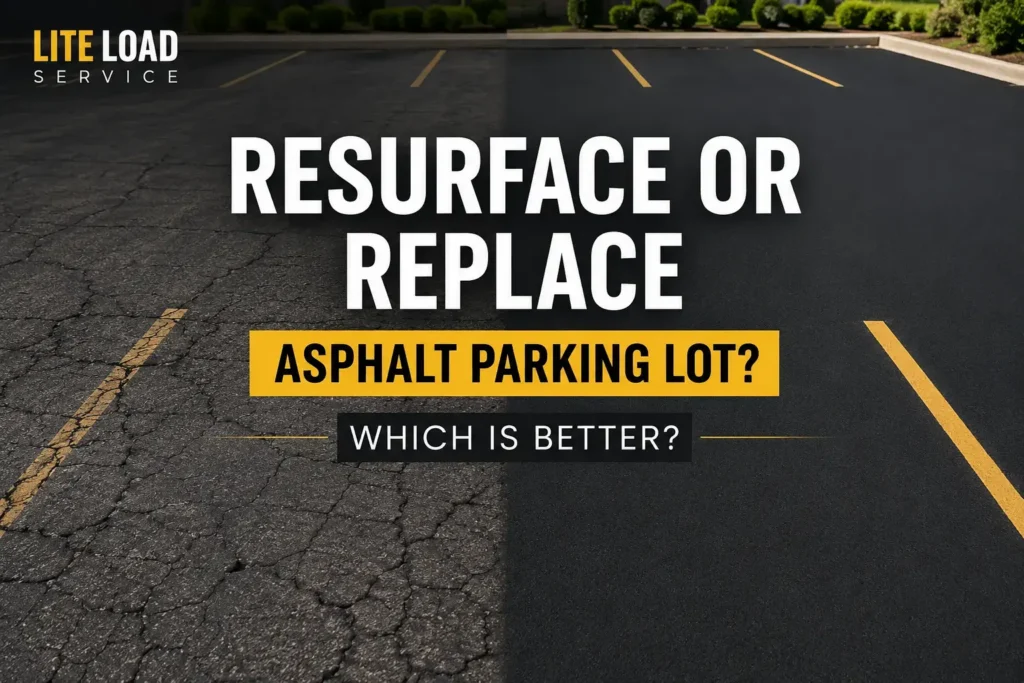
Whether you should resurface or replace asphalt parking lot pavement comes down to what’s happening underneath the surface, not just what you can see. Resurfacing works when the base beneath the asphalt is still stable, and the damage is limited to the top layer. Replacement is the right call when the pavement structure itself has failed, whether that shows up as widespread cracking, chronic drainage problems, or potholes that keep returning after repair.
A cracked parking lot does not always need to be replaced. In some cases, resurfacing is enough. In others, the damage runs deeper and calls for a new parking lot.
So, how do you know whether to resurface or replace an asphalt parking lot? The answer comes down to the condition of the existing pavement and what is causing the damage.
Lite Load Asphalt has helped West Michigan businesses repair, resurface, and replace parking lots since 1997. This guide explains what to look for before deciding which option makes sense for your property.
Quick Comparison: Resurfacing vs. Replacement
| Resurfacing may make sense | Replacement may make sense |
| Surface cracking, not deep or widespread | Deep structural or alligator cracking |
| Isolated wear or fading | Potholes that keep coming back |
| Stable, intact base | Failed or unstable base |
| Working drainage | Standing water or drainage failures |
| Limited, contained damage | Damage covering large sections of the lot |
If most of your checkmarks land on the left, resurfacing is worth discussing with a contractor. If they land on the right, plan for a bigger conversation about full parking lot replacement. Most lots fall somewhere in between, which is why an onsite inspection matters more than a visual guess from the office window.
What Does Asphalt Resurfacing Fix?
Asphalt resurfacing adds a new asphalt surface over an existing pavement structure that is still strong enough to support it. Depending on the condition of the current surface, this may involve milling off the top layer first to create a clean, even base for the new asphalt, or it may involve paving directly over the existing surface if it’s smooth enough.
Resurfacing corrects:
- Surface-level cracking and weathering
- Faded, oxidized, or rough-textured asphalt
- Minor rutting in the top layer
- Cosmetic wear from years of traffic and sun exposure
Resurfacing does not correct:
- A base that has lost load-bearing strength
- Drainage problems caused by grading or subsurface issues
- Cracks that have already reached the base layer
- Settlement caused by soil or subgrade movement
An overlay is a strong option when the pavement structure below is intact. It’s a poor option when it’s being used to hide a problem that will just resurface, literally, within a season or two.
When Is Full Parking Lot Replacement the Better Choice?
Replacement means removing the existing asphalt, addressing the base and subgrade underneath, and rebuilding the pavement structure from the ground up. This is the right move when the problems go deeper than the surface.
Signs that point toward replacement instead of resurfacing:
- Widespread alligator cracking across large sections of the lot
- Potholes that return within months of being patched
- Severe rutting or wheel-path depressions
- A base that has failed, feels soft, or shifts under load
- Standing water that doesn’t drain after storms
- A long history of repeated patching in the same spots
- Noticeable settlement or sunken areas
- Extensive frost heave damage from repeated Michigan winters
- A lot that has simply reached the end of its useful pavement life
If the pavement base has failed, a new asphalt surface alone will not correct the underlying structural problem. Paving over broken subgrade is a short-term cosmetic fix, and the same cracking pattern will usually reappear in the same places within a year or two.
Can You Resurface a Parking Lot With Cracked Pavement?
Yes, in many cases. Cracking alone does not automatically mean an asphalt parking lot needs full replacement. What matters is the type of cracking and how deep it runs.
Surface-level Cracking
Fine, shallow cracks scattered across the lot are usually a wear pattern, not a structural warning sign. If the base underneath tests solid, these lots are often good resurfacing candidates once the cracks are sealed or milled out.
Block Cracking
Large, rectangular cracks that break the surface into blocks usually point to asphalt aging and oxidation rather than base failure. Severity matters here. Light block cracking on a stable base can often be resurfaced. Extensive block cracking paired with other symptoms is a different story.
Alligator Cracking
This pattern of interconnected, many-sided cracks is a structural warning sign. It typically means the base or subgrade has lost the ability to support the load above it. Resurfacing over active alligator cracking usually just delays a bigger repair.
Deep or Widespread Cracking
When cracks run through multiple sections of the lot, connect into larger networks, or show up alongside potholes and soft spots, that’s a strong signal the pavement structure has failed, and replacement should be on the table.
Cracks do not automatically mean an asphalt parking lot needs full replacement. What tells the real story is whether the cracking is confined to the surface or has worked its way down into the base.
What Are the Signs Your Parking Lot Needs Replacing?
If you’re checking for signs your parking lot needs replacing, look for these warning signs and what each one usually means:
- Widespread alligator cracking: The base is losing load-bearing strength across a large portion of the lot.
- Potholes returning after repair: Water is still getting into the base, and patching isn’t addressing the source.
- Soft or spongy pavement: The base has weakened and can no longer support vehicle loads.
- Standing water after rain: Grading or subsurface drainage has failed, and water is likely reaching the base.
- Drainage problems near curbs or drains: Water isn’t leaving the lot the way it was designed to, which accelerates deterioration.
- Extensive patchwork across the lot: A pattern of frequent, scattered patches usually means the underlying problem was never fixed.
- Damage covering a large share of the lot: Isolated problems can often be repaired. Damage spread across most of the surface usually calls for replacement.
How Do You Know Which Option Your Parking Lot Needs?
The visible surface can’t always tell you the full story. Two lots that look equally rough can need completely different treatments once you check what’s underneath.
| What you see | What it may indicate | Likely approach |
| Faded surface, minor hairline cracks | Normal aging, base intact | Resurfacing |
| Scattered potholes, isolated area | Localized base weakness | Targeted repair, then resurface |
| Alligator cracking in high-traffic lanes | Structural fatigue from loading | Replacement, at least in that section |
| Standing water, soft edges | Drainage or grading failure | Replacement with drainage correction |
| Frequent patches in the same spots | Underlying cause never addressed | Full evaluation, likely replacement |
A parking lot does not need to be crack-free to qualify for resurfacing. What matters is whether the pavement underneath is still stable.
The Federal Highway Administration explains that asphalt overlays can restore the pavement surface but are not a substitute for fixing deeper structural problems. That is why a contractor should look beyond visible damage before recommending resurfacing. If the problem is deeper than the surface, replacing the affected sections may be the better choice.
Is Resurfacing Always Cheaper?
No, not always, and it’s worth being direct about that. Resurfacing usually costs less upfront than full replacement because it involves less excavation, less base work, and less material. But choosing resurfacing purely because it’s the lower number on paper can backfire if the base has already failed.
Here’s the trade-off to weigh:
- Initial project cost. Resurfacing typically costs less to install than a full rebuild.
- Repair frequency. A resurfaced lot over a failing base tends to develop the same problems again within a couple of years, which means paying for repairs sooner than expected.
- Remaining pavement life. Replacement resets the clock on the entire structure. Resurfacing over a sound base extends life, but resurfacing over a bad base doesn’t extend much of anything.
- Future disruption. Repeating a paving project sooner than planned means more closures, more scheduling headaches, and more disruption to customers or employees.
- Long-term value. The cheaper option today isn’t cheaper if it needs to be redone in three years instead of holding for ten.
Service life for either option varies based on traffic volume, drainage, construction quality, climate, and how well the lot is maintained afterward. There’s no fixed number that applies to every property.
What Should a Contractor Inspect Before Recommending Resurfacing?
What that inspection should cover:
- Cracking patterns across the full lot, not just the areas that look worst
- Pavement thickness, usually checked with core samples or existing records
- Base stability, by probing or coring down to the aggregate layer
- Traffic patterns, since heavy-use lanes wear differently than parking stalls
- Repair history, since a lot that’s been patched repeatedly tells its own story
- Age and maintenance history, since a well-maintained older lot can outperform a neglected newer one
The Bottom Line
The decision to resurface or replace asphalt parking lot pavement comes down to one question: is the structure underneath the surface still sound? Resurfacing makes sense when the base is stable, and damage is limited to the top layer. Replacement is usually the right call when structural failure, drainage problems, or widespread deterioration have already taken hold.
Not sure which option your parking lot needs? Lite Load Services can assess the pavement, identify the source of the damage, and help you choose the right paving solution for your property. Schedule an inspection before committing to either option.