

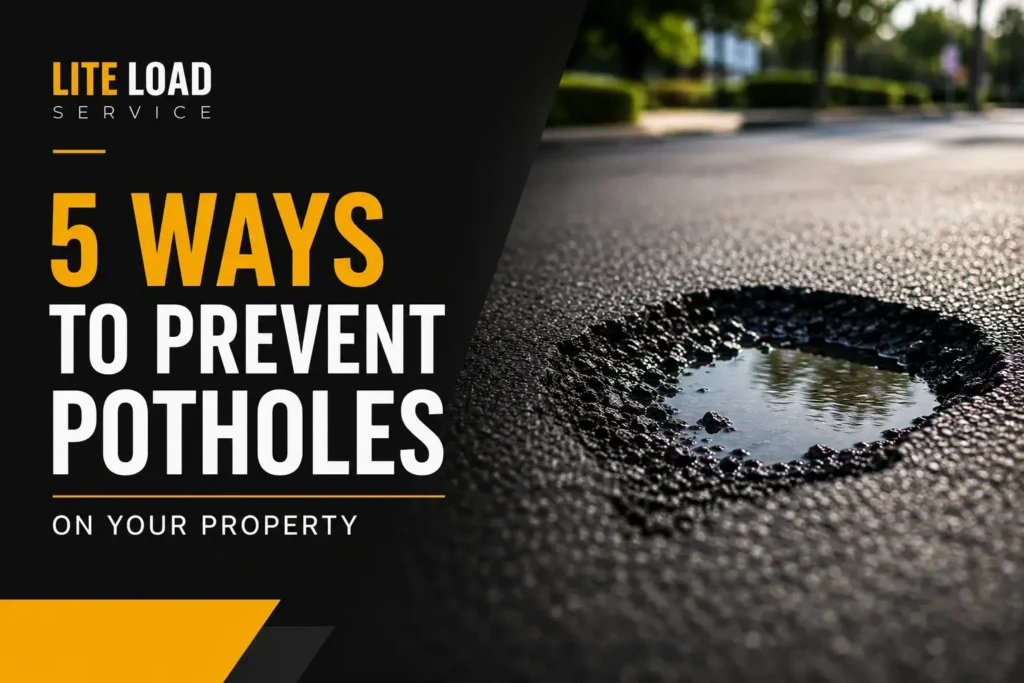
Preventing pavement damage starts with addressing small issues early. Fix cracks before water reaches the surface, keep drainage clear to prevent standing water, and inspect high-traffic areas, such as entrances and loading zones, more often. Seal and patch minor defects before they develop into larger pavement failures. If cracks, potholes, or drainage problems keep recurring, schedule a professional inspection to identify the underlying issue and determine the appropriate repair.
__________________________________________________________________________
Potholes rarely appear out of nowhere. Water finds its way into a crack, freezing temperatures widen the opening, and repeated traffic breaks the weakened pavement apart. If you catch that process early, you can prevent potholes before they cost you a repair bill.
Small maintenance issues are far easier to address than a failed section of pavement. Lite Load Asphalt works with commercial property owners across West Michigan who want to catch these problems before they spread.
-
Fix Cracks Before Water Gets Below the Surface
Seal or patch cracks as soon as you notice them. Water that gets under the surface weakens the base and speeds up damage.
A crack is more than a cosmetic problem. Once water gets underneath the surface, it softens the base layer that supports the pavement above it. In West Michigan, freeze and thaw cycles make this worse, since water expands as it freezes and pushes the crack wider each time.
| What to Check | Why It Matters |
| Hairline cracks that have widened since last inspection | A growing crack means water has already reached the base |
| Cracks near drains, curbs, or expansion joints | These spots collect extra water during rain and snowmelt |
| Cracks that trap dirt or debris | Trapped debris holds moisture against the surface longer |
| Multiple small cracks connecting | A connected network usually points to a larger area of weak pavement |
Do small cracks really need attention? Yes. A crack that costs little to seal today can turn into a section of failed pavement after one winter of freeze and thaw cycles.
-
Keep Water Moving Away From the Pavement
Drainage problems and pothole formation go hand in hand. If water cannot move off your pavement, it sits there and slowly breaks the surface down.
| Stage | What’s Happening | What to Do |
| Problem | Standing water pools in low spots, near curbs, or around blocked drains | Walk the property after heavy rain and mark where water collects |
| Why it matters | Pavement that stays wet loses strength faster, and refreezing overnight adds more stress | Clear debris from drains and catch basins on a regular schedule |
| Ongoing risk | The same low spot fills up every time it rains | Have the area regraded rather than patched repeatedly |
Blocked drains and poor drainage rarely fix themselves. Addressing them alongside any pavement repair gives that repair a much better chance of holding up.
-
Inspect High Traffic Areas More Often
Does heavy traffic cause potholes? Not on its own. Traffic speeds up pavement damage that is already weakened by water or age, which is why these areas fail first.
| High-traffic Area | Why it Wears Down Faster |
| Entrances and exit lanes | Constant braking and turning stress the same stretch of pavement |
| Loading zones and dumpster areas | Heavy vehicles and repeated stops add concentrated weight |
| Drive lanes | Continuous daily traffic wears the surface unevenly |
| Delivery truck turning areas | Sharp turns twist and shift weakened pavement |
| Spots where vehicles brake or accelerate | Repeated force in one spot breaks down surface bonds faster |
Check these areas on a shorter inspection cycle than the rest of your lot, especially after winter.
-
Seal and Maintain the Pavement Before It Fails
Routine maintenance is one of the most effective ways to prevent potholes over the long term. Crack sealing keeps water out. Sealcoating, where appropriate, adds a layer of weather protection. Timely patching stops small defects from spreading.
Small issue now vs. larger problem later:
| Small Issue (Address Now) | Larger Problem (If Ignored) |
| Hairline crack sealed in an hour | Crumbling section requiring excavation and repaving |
| Minor surface wear caught during routine inspection | Base failure that spreads under repeated traffic |
| Small patch applied to a soft spot | Full-depth pothole in an active drive lane |
| Delivery truck turning areas | Sharp turns twist and shift weakened pavement |
Does sealcoating prevent potholes? Sealcoating alone will not stop a pothole from forming, but it protects the surface from water and UV damage, which reduces how fast cracks develop in the first place.
-
Schedule an Asphalt Inspection When You See Warning Signs
At some point, visual checks are no longer enough to prevent potholes on their own. If the same problems keep returning, something is likely happening below the surface.
Call for an inspection if you notice:
- Standing water that returns after every rain
- Deep or widening cracks
- Crumbling edges along curbs or drive lanes
- Depressions or low spots that never fully drain
- Alligator cracking, where cracks form a connected pattern
- Existing potholes, even small ones
- Areas that have already been patched more than once
- Pavement that feels soft or spongy underfoot
If two or more of these sound familiar, a professional can assess what’s happening beneath the surface, not just the visible damage on top.
Why Potholes Keep Coming Back
Patching the same spot repeatedly is frustrating, and it usually means the underlying problem was never fixed. Understanding what causes potholes in parking lots helps explain why.
If you see this… look for this:
| What you’re seeing | What’s likely causing it |
| Recurring potholes in the same spot | A nearby drainage issue feeding water into the base |
| Patches that fail quickly | A weak or unstable pavement base |
| Damage appearing every spring | Water that got in before the winter freeze |
| Cracking spreading outward from one area | Repeated heavy traffic on already weakened pavement |
Fixing the visible hole without addressing why it formed usually means the same spot fails again next season.
Why West Michigan Pavement Needs Regular Attention
How does West Michigan weather affect pavement? Repeated freeze and thaw cycles expand existing cracks all winter, and spring meltwater has nowhere to go if drainage isn’t working.
- Winter: Snow and ice sit on the pavement, and meltwater works its way into any open crack.
- Freeze and thaw cycles: Water expands each time it freezes, widening cracks a little more with every cycle.
- Spring: Winter damage becomes visible once the snow clears, which is why early inspections matter.
- Summer: Heavy traffic returns to pavement that may already be weakened from the winter.
Lite Load Asphalt has worked with property owners across the region on pothole repair that West Michigan properties need after a hard winter, and understands how local weather patterns affect pavement condition.
When Prevention Is No Longer Enough
Is every pothole an emergency? No. Most can be scheduled as routine repairs. A smaller number need immediate attention.
| Can usually wait for routine repair | Needs prompt attention |
| A single small pothole in a low-traffic corner | A pothole in an active traffic lane |
| A pothole that has stayed the same size | A pothole that keeps growing week over week |
| Minor surface wear with no safety impact | Multiple potholes appearing across the same lot |
| Cosmetic cracking with no depth | Damage affecting customers, employees, or deliveries |
Looking for emergency pothole repair near me? Start with a local contractor who can inspect the pothole, identify the cause, and recommend the right repair.
Who Should Handle the Repair?
Who fixes potholes? Asphalt contractors handle pothole repair along with the maintenance work that keeps the problem from returning.
Before repairing the area, a qualified contractor typically:
- Checks the surrounding pavement condition, not just the hole itself
- Looks for signs of a weak or unstable base
- Evaluates nearby drainage for related issues
If you’re asking who fixes potholes in Michigan, the answer is a licensed asphalt contractor with experience in both repair and the maintenance that prevents the same spot from failing again.
Conclusion
Potholes are the result of problems that started small: a crack that let water in, a drain that stayed blocked, or a low spot that never fully dried out. Catching those issues early is still the most practical way to prevent potholes and avoid a larger repair down the road. Walk your property regularly, address cracks and drainage as you find them, and bring in a professional once warning signs start to repeat.
If your pavement needs an inspection, repair, or a maintenance plan built around your property, contact Lite Load Asphalt to schedule an assessment.